
How to Do a Quarterly Business Review for your small business
A quarterly business review for your small business doesn’t require a boardroom, a slide deck, or a finance team. It requires about 90 minutes, honest
answers to a few key questions, and the willingness to look at what actually happened, not just what you planned.
If you’re reading this in late March, you’re at one of the most valuable moments in your business year. Maybe Q1 went exactly as planned.
More likely, some things worked, some didn’t, and a few surprises showed up uninvited. Either way, right now is the perfect time for a spring business reset: a chance to pause, take stock, and decide what Q2 looks like on purpose rather than by default.
Most quarterly business review content online is written for enterprise teams running client-facing QBRs with dashboards and stakeholder presentations.
You need a process that works when you are the CEO, the marketing department, and the finance team all at once.
This guide gives you exactly that: a step-by-step framework for reviewing your quarter, a ready-to-use checklist, and a system for turning this single review into a quarterly habit that compounds over time.
Why a Quarterly Review Matters More Than Your Annual Plan
Annual planning gets all the attention in January.
But here’s what most small business owners discover by March: twelve months is too long a planning cycle when you’re running a lean operation.
The business landscape shifts too fast. A new competitor emerges, an algorithm changes, a product that was selling well in January flatlines by February.
If your only checkpoint is December, you’re driving blind for most of the year.
Quarterly reviews give you four chances per year to course-correct instead of one end-of-year reckoning.
Think of it this way: if you launched a new offer in January that underperformed, do you really want to wait until December to figure out why?
A 90-day cycle is short enough to stay responsive and long enough to see real patterns. You can spot what’s working before you accidentally abandon it, catch what’s draining your time before it eats another full quarter, and set goals that are specific enough to actually measure.
This is exactly why planning systems built around quarterly cycles (rather than a single January-to-December timeline) tend to work better for business owners who need to stay nimble.
For a small business, the quarterly review is the single most valuable hour you can spend all quarter.
A 5-Step Framework For Your Quarterly Review
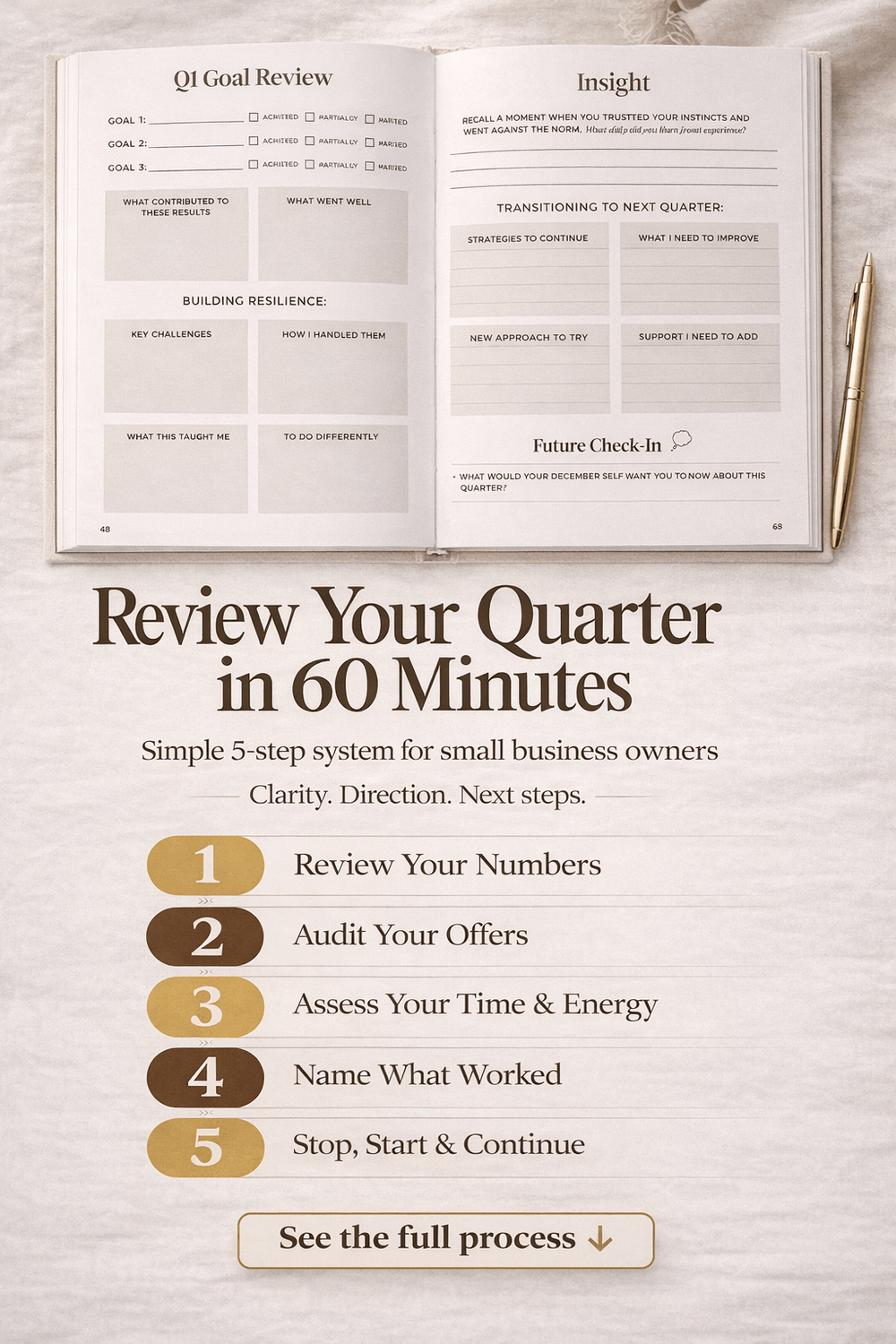
This framework is designed for a business of one, or a very small team. You can work through all five steps in a single 60- to 90-minute sitting. Grab a coffee, open your planner or a blank notebook, and give yourself permission to be honest, because that matters more than any template you could download.
Step 1: Review Your Numbers (The Honest Look)
Start with what actually happened financially.
Pull your revenue and expense totals for the quarter. Compare them to the previous quarter and to any goals you set in January.
For most small business owners, the numbers that matter fit on one hand: total revenue, total expenses, profit margin, number of clients or customers, and average transaction value.
The core question is simple: did the money side of this business move in the direction I wanted?
Ask yourself: Did I earn what I expected to earn this quarter, and if not, can I name the specific reason why?
Step 2: Audit Your Offers and Revenue Streams
Now look at what generated that revenue. What sold well? What didn’t move? What did you spend significant time on that produced little or no income?
This is where most coaches and creators often discover they’ve been pouring energy into a low-performing offer out of habit or emotional attachment.
Maybe you spent weeks building a course that three people bought while your one-on-one service quietly had a waitlist.
The numbers don’t lie, but you have to look at them offer by offer to see the full picture.
Ask yourself: If I could only keep two of my current offers or revenue streams, which two would I keep, and why?
Step 3: Assess Your Time and Energy
This is the step that no enterprise QBR includes, but every small business owner desperately needs. When you’re the entire team, how you spend your time is the business. There’s no delegating around a bad time allocation.
Look at your calendar honestly. If you don’t track your time formally, estimate it: what percentage of your work hours went to client delivery, marketing, admin, and strategic work?
Does that breakdown match your priorities? The answer is an uncomfortable one for most. Admin and reactive tasks tend to eat the hours that should go to growth.
Ask yourself: What task or commitment consumed disproportionate time or energy this quarter, and what would I need to change to fix that in Q2?
Step 4: Evaluate What Worked (and Name It)
This step gets skipped more than any other. Most coaches and creators tend to rush past their wins and fixate on what went wrong. But naming what worked with specificity is where your Q2 strategy lives.
Specificity sounds like: “The email sequence I launched in February converted at 4.2% and brought in 12 new clients.” Or: “My Pinterest content drove 40% more traffic in March than in January.”
That level of detail turns a vague good feeling into a repeatable strategy.
Ask yourself: What’s one thing I did this quarter that I want to do more of, and what made it work?
Step 5: Identify What to Stop, Start, and Continue
Now pull it all together. Based on your numbers, your offer audit, your time assessment, and your wins, sort your activities into three buckets: stop, start, and continue.
The “stop” column is the hardest for small business onwers because everything feels essential when you’re the whole team. Give yourself permission here.
Stopping something is strategic pruning, not failure. Every hour you reclaim from something that isn’t working is an hour you can redirect toward something that is.
Ask yourself: What am I doing out of obligation or habit that no longer serves my business goals?

If you use a quarterly planner like Strategic by Design, you’ll find dedicated space for this exact review process. The quarterly reflection pages walk you through each of these steps so you’re not starting from scratch every 90 days.
But whether you use a planner or a blank notebook, the framework above gives you everything you need.
Quarterly Review Checklist for Small Business
Here’s the at-a-glance version.
Bookmark this page, screenshot it, or copy it into your planner. The goal is to have this ready so your next quarterly review takes 60 minutes instead of a full day.
☐ Pull revenue and expense totals for the quarter
☐ Compare actual revenue to projected or goal revenue
☐ Calculate profit margin and compare to the prior quarter
☐ List each offer or revenue stream and its individual performance
☐ Identify your top-performing and lowest-performing offer
☐ Review how you spent your time: client work vs. marketing vs. admin vs. strategy
☐ Name three specific wins from the quarter
☐ Name one thing that consumed disproportionate time or energy
☐ Decide what to stop, start, and continue in Q2
☐ Set two to three measurable goals for next quarter
☐ Update your financial projections for the next 90 days
☐ Schedule your next quarterly review date and put it on the calendar now
The final item on that list, scheduling your next review before you finish this one, is the single best way to make quarterly reviews a habit instead of a one-time exercise.
The 90-Day Business Review: Why Looking Back Is the First Step of Planning Forward
Here’s what most people get backwards: they jump straight into planning the next quarter without reviewing the last one. It feels productive: new goals, fresh energy, a clean slate.
But a 90-day plan without a review behind it is just wishful thinking.
You end up setting the same goals you didn’t hit last quarter, with no clarity on why they didn’t land.
The quarterly review and 90-day planning are two halves of one cycle. The review looks backward: what happened, what worked, what didn’t.
The plan looks forward: what are you prioritizing, what are you building, what does success look like in 90 days? Skip either half and the cycle breaks.
After completing your review, try writing three “I now know...” statements. For example: “I now know that my group program fills faster from Instagram DMs than from my email list.” Or: “I now know that I spent 15 hours on admin tasks that could be automated for $50 a month.”
These statements are intelligence extracted from real data, and that’s what makes your next quarter’s plan sharper than the last one.
How to Make Your Quarterly Review a Built-In Habit (Not a One-Off Exercise)
The review you do once is helpful. The review you do every quarter is transformative. The challenge is that most small business owners building in the margins of a full life have no system holding the practice in place, so January motivation fades, the calendar reminder gets snoozed, and the spreadsheet you meant to fill out gets buried under everything else.
Here are three ways to make it stick.
First, schedule the next review before you finish this one. Open your calendar right now and block 90 minutes at the end of June for your Q2 review. Treat it like a client meeting: non-negotiable, not something you’ll “get to when things slow down.” Things never slow down. You know that.
Second, use a physical planning tool.
There’s a reason paper-based planning keeps showing up in productivity research. Writing by hand creates a different quality of reflection than typing into a digital document. When your quarterly review lives in a physical planner alongside your goals and daily priorities, it becomes part of the rhythm instead of a separate task you have to remember to do.

If you’re looking for a quarterly planner for business owners that builds the review process into the planning system itself, Strategic by Design was designed for exactly this.
Each quarter opens with dedicated reflection pages that map to the framework in this article, so you’re never starting from a blank page. It’s the tool I’d recommend if you want quarterly reviews to become a practice, not a project.
Third, find an accountability partner or community.
Share your quarterly review highlights (not the entire review, just the top insights) with a business friend, a mastermind group, or an online community. Making the commitment visible makes it harder to skip, and hearing how others approach their reviews will sharpen your own process over time.
The best thing you can do for Q2 is finish Q1 well.
A quarterly business review takes 60 to 90 minutes and gives you strategic clarity that most small business owners never access, simply because nobody told them it could be this simple.
Block 90 minutes this week, pull up the checklist above, and open your planner or a blank notebook. Review Q1 honestly. Then decide what Q2 looks like on purpose, not by accident.
Frequently Asked Questions
1. What is a quarterly business review for a small business?
A quarterly business review is a focused check-in every 90 days where you step back from daily tasks and look at the health of your business as a whole. You review your goals, numbers, marketing, operations, and capacity so you can decide what to keep, fix, or drop in the next quarter.
2. Why should I bother doing a quarterly business review if I’m a solopreneur?
As a solopreneur, you are the CEO, marketing team, and operations in one person—so it’s easy to stay stuck in “doing” mode. A quarterly business review gives you protected time to think strategically, spot what’s actually driving results, and make intentional adjustments instead of running on autopilot.
3. How is a quarterly business review different from my monthly check‑ins or an annual review?
Monthly check‑ins are about short-term tasks and minor tweaks; an annual review looks at the big picture of your entire year. A quarterly business review sits in the middle: it’s frequent enough to correct course quickly, but spacious enough to see patterns in your offers, revenue, and marketing over 90 days.
4. What should a simple quarterly business review include?
A simple but powerful quarterly review can be built around five core elements:
Your goals vs what actually happened
A quick financial snapshot (revenue, profit, key expenses)
What worked well and what didn’t
Lessons learned and patterns you notice
1–3 clear priorities for the next quarter
You can always add sections for marketing, operations, or personal wellbeing as your business grows.
5. Which numbers and metrics should I look at in my quarterly review?
Focus on a small set of metrics that truly show whether your business is healthy. For most small online businesses, that includes: total revenue, profit, cash on hand, number of clients or sales, conversion rates for your main offer or funnel, and key audience numbers (like email subscribers).
6. How long should a quarterly business review take, and how often should I do it?
Most small business owners do a quarterly review four times a year and block 60–120 minutes for it. Some turn it into a “CEO half day” so they have time not just to review, but also to make decisions and sketch the next 90-day plan.
7. What questions should I ask myself during a quarterly business review?
You can keep it simple by coming back to questions like:
What were my goals this quarter, and what actually happened?
What brought in the most revenue or clients?
What drained my time or energy without much return?
What do I want to stop, start, and continue next quarter?
These questions help you turn data and experiences into practical next steps.
8. What Exactly is Strategic By Design Planner?
Strategic by Design is an undated quarterly business planner for entrepreneurs and small business owners that turns your 90-day business review into a clear, focused action plan. It guides you through quarterly reflection, monthly goal-setting, and progress tracking so you always know what to work on next.

Download the free monthly planner

Grow your business by design
Stay informed with valuable business goal success tips delivered straight to your inbox.