
How to Do a Mid-Year Business Review
A Five-Area Framework for Coaches, Creators, and Small Business Owners Who Want to Finish the Year with Intention
Most people you know are mentally halfway into summer already.
The vacations are being planned, the pace is quietly slowing, and the psychological shift from "first half" to "coasting toward fall" has already started.
It's the most natural rhythm especially for those building a business in the margins of a full life.
But there is a window that sits ticked in between the end of May and the start of that slower season, that strategic business owners know better than to leave empty.
With two full quarters are behind you. That is six months of real business activity: client conversations, marketing experiments, revenue patterns, and spending decisions you can actually measure.
That goldmine of information does can get buried in wasteland if you never stop to examine it. A mid-year business review is how you examine it, before you make a single decision about the second half of your year.
A mid-year business review is a deliberate look at the evidence your business has already generated, so that what comes next is grounded in reality rather than optimism.
It is one of the most high-value things a small business owner can do, and most people skip it entirely.
Is this necessary for a coaching or digital product business?
Most online business owners skip the mid-year review, keep working, stay busy, and make decisions based on instinct and momentum.
That is not always wrong, but it is not the same as making decisions based on data.
And then December arrives, and the year-end review surfaces what the mid-year review could have caught six months earlier.
The offer priced for the wrong client.
The marketing channel that was costing hours without moving leads.
The monthly payments quietly pulling money from the business account that nobody had looked at in months.
A proper mid-year business review surfaces all of it while there is still meaningful runway left to act on what you find.
Right after the summer slowdown comes the most commercially active period of the year. Consumer spending picks up in September, accelerates through October, and peaks through the holiday season in November and December.
For coaches, creators, and small business owners with products or programs to sell, Q4 is often where the most significant revenue gets made.
But Q4 results are largely shaped by the groundwork laid in Q3. And Q3 strategy gets set right now, in June.
Walking into the second half of the year without a clear picture of what is actually working in your business means spending the highest-opportunity season improvising.
The mid-year reset is what changes that. It is how you position yourself to harvest during the spending season rather than scramble through it.
Why 90-Day Cycles Are the Right Frame for This Review
I plan in quarters because 90 days is enough time to commit to a real strategy, execute it consistently
And accumulate enough data to reach a reliable conclusion. A conclusion you can actually build on.
Earlier this year, I wanted to test Pinterest as a long term traffic channel
I did the research, found a Skool community focused on Pinterest only.
I joined and upgraded to their premium membership right away so I could access their group boards, which carried millions of monthly views, and the implementation tools that came with that level of access.
I followed their strategy exactly as it was taught, tracked the growth week by week, and took honest notes on what I was observing.
At the end of 90 days, I had a clear, data-backed answer about whether Pinterest was a viable channel for this stage of my business.
A real conclusion I could build a decision on.
That is what quarterly cycles make possible. And the mid-year point is exactly where that kind of evidence becomes most useful.
You have enough accumulated to see real patterns, and enough year remaining to act on them.
The Five-Area Mid-Year Business Review
The structured review process I use is built around five areas.
Each one is designed to surface what your business is already showing you, before you make a single plan for where it is going.
Working through all five gives you a complete picture that a metrics glance will never give you.
Overall Business Health
This is where you take an honest look at the full picture of the first half of the year.
What activities are generating the best results relative to the time and energy they require?
What bottlenecks have you been encountering?
What is consuming hours without producing anything meaningful?
Many small business owners are carrying activities that no longer serve them, out of habit or because they have never stopped to ask the question directly.
This honest review asks it.
Ideal Customer Check-in
Your niche evolves over time, and so do you.
This review area asks you to reconnect with who your work is actually for right now, not who it was designed for 18 months ago.
How has your ideal audience evolved?
How have you evolved in how you serve them?
Where does your messaging or your offer no longer quite match the reality of who you are actually reaching?
This is one of the most commonly skipped parts of a business review, and it is often where the largest positioning mismatches are sitting quietly under the surface.
Marketing Strategy Effectiveness
This section separates the activities that make you feel productive from the ones that are actually moving revenue.
Which channels brought your best clients or customers in the first six months?
Which ones kept you consistently active but generated nothing you could measure?
Which platform feels natural to show up on, and which one are you tolerating because you feel like you should?
For coaches, creators, and small business owners especially, this is where the data tends to be the most clarifying, and the most uncomfortable.
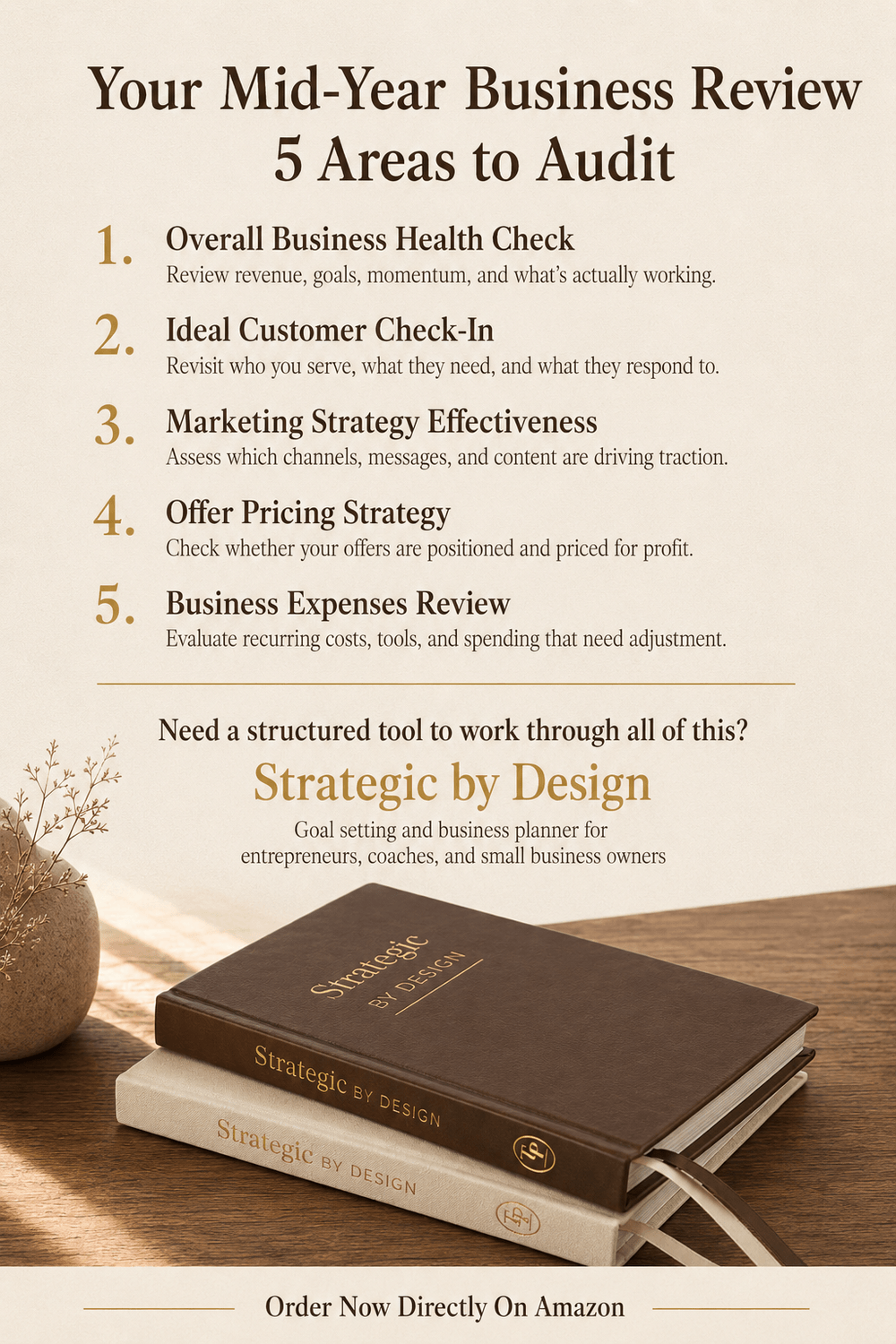
Offer Pricing Strategy
Undercharging is another common miss, simply because most people never pause to examine the stories they tell themselves about what people will actually pay.
This section asks you to look at your current pricing, identify which offers need a review, and commit to one small pricing experiment in the next 90 days.
Not a full overhaul. One honest step forward, based on what the first half of the year showed you about how your clients respond to what you charge.
Business Expenses
Pull up your bank statement and look at every subscription, tool, and service you are currently paying for, including the ones you forgot about.
This section adds up what you are canceling and asks you where those recovered funds get redirected toward what is actually moving the business forward.
Taken together, these five areas give you a complete and honest picture of where your business actually is, before a single plan gets made for where it is going next.
Data Before Decisions
The instinct at the halfway point is to jump straight to new goals. To rewrite the plan, get re-energized, and push harder into Q3 and Q4.
But goals built without data are just hopes with structure. The mid-year review flips the sequence: clarity first, then planning.
When you know what your business is actually showing you, the right goals become obvious rather than aspirational.
The Tool I Use to Do This
The structured framework behind this entire review process is built into the Strategic by Design Planner for Entrepreneurs.
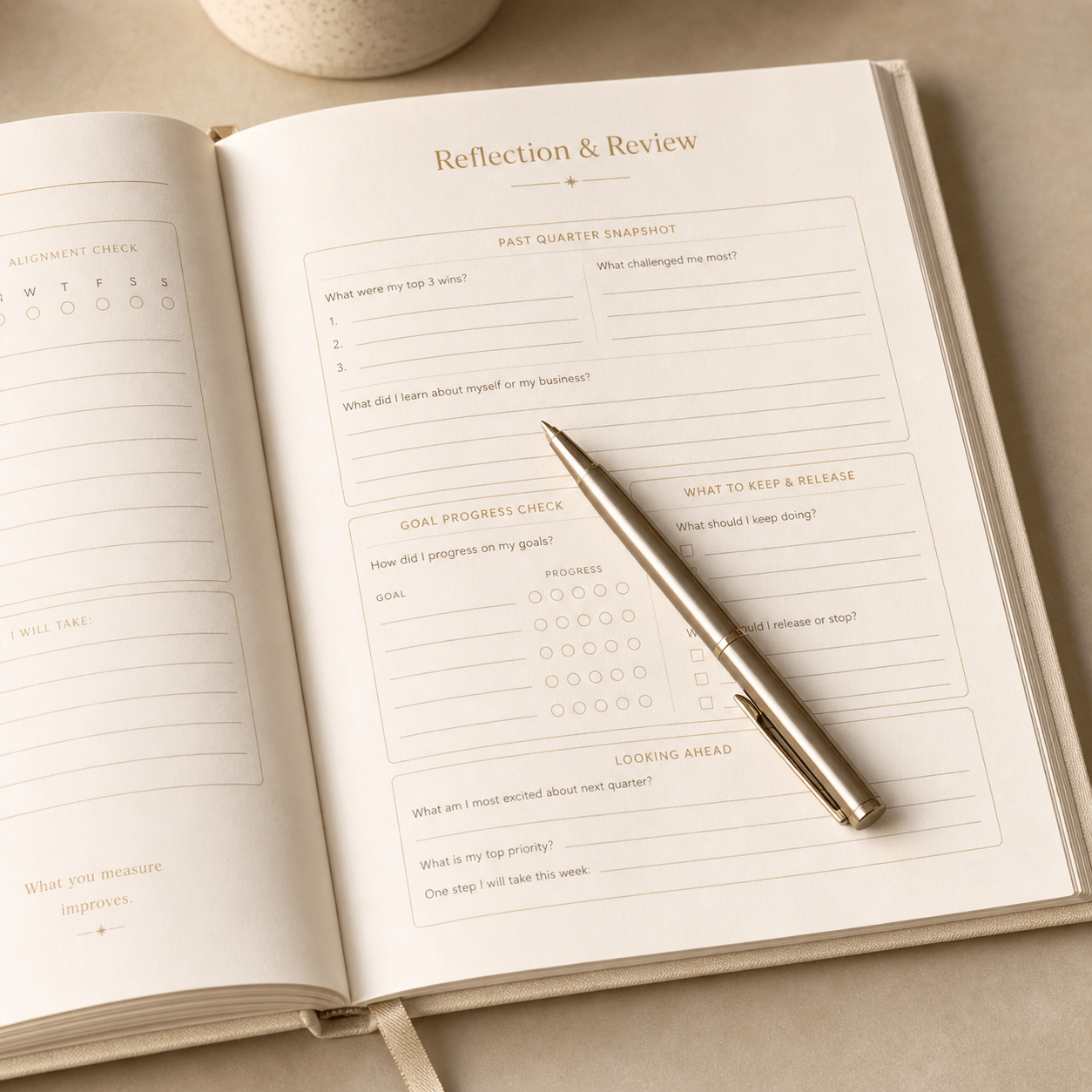
Part One of the planner is a complete business clarity journal with guided prompts across all five review areas.

I sit down with it at the start of every year and return to those same prompts at the halfway point, because the questions are built to surface what a quick glance at your dashboard will not catch.
It is the tool that holds the whole process together for me.
If you want to work through a mid-year business review with structure and guided prompts rather than a blank page, you can grab a copy directly on Amazon here.
Put the First Half to Work: Make The Day Count.
The second half of the year does not have to be a repeat of the first.
What makes the difference between business owners who finish December with clarity and those who arrive there wondering where the time went is rarely talent or effort.
It is the decision to pause, look honestly at what the data is already showing, and let that inform what comes next.
It takes a few focused hours, it asks uncomfortable questions, and it gives you something far more valuable than a motivational reset. It gives you a foundation to build on.
So before summer fully pulls your attention away, sit down with what the first half of your year has already taught you.
That is where your strongest second half begins.
Frequently Asked Questions About Mid-Year Business Reviews
How long does a mid-year business review actually take?
A thorough review across all five areas takes between two and four hours when you are working from structured prompts and have your relevant data within reach.
Breaking it into two sessions tends to produce more honest answers than rushing through it in a single sitting. The first session for the reflection areas, the second for translating what you found into decisions about Q3 and Q4.
When is the right time to do a mid-year business review?
Late May through mid-July captures the right window. The goal is to complete it before the summer slowdown fully sets in, so you have time to act on what you find before Q3 is already underway. If you are reading this in June, you are right on time.
What is the difference between a mid-year review and just checking my numbers?
Checking your numbers tells you what happened. A mid-year business review asks why it happened and what it means for your decisions going forward. Revenue figures, lead sources, and conversion rates are inputs into the review, not the review itself. The goal is to move from data to insight to action, which is a different exercise from reading a spreadsheet.
Do I need to have set clear goals at the start of the year for this to be useful?
No. Even without clearly defined January goals, the first half of the year has still generated real data about what is working in your business, where your clients or customers are coming from, and where your time and money are actually going. The mid-year review works from real business activity, not from a plan you may or may not have written in January.
How is a mid-year review different from a quarterly review?
A quarterly review is a focused check-in on a specific 90-day cycle: what you set out to do, what actually happened, and what to carry forward. A mid-year review is broader in scope.
It steps back from the quarterly view and looks at patterns across two full cycles together, which surfaces a different quality of signal. Both are valuable, and they work well together as part of the same planning system across a full business year.
Is there a tool specifically designed to support this kind of quarterly review process?
Yes, and it is the one I use personally. The Strategic by Design Planner is a goal planner and monthly business planner built for entrepreneurs, coaches, and small business owners who want a structured system rather than a blank notebook.
It is designed to help you map your annual vision, set 90-day priorities, and run structured quarterly reviews with guided reflection prompts that surface what is driving revenue and what is draining it.
It adds the strategic layer your day-to-day scheduling tools and daily planners were never built to handle. You can order your copy directly on Amazon.

Download the free monthly planner

Grow your business by design
Stay informed with valuable business goal success tips delivered straight to your inbox.